
Dark Souls is a 2011 video game developed by FromSoftware, a Japanese studio, that has been hugely influential since its release, even inspiring a subgenre of action roleplaying games known as Soulslikes. (For clarity’s sake, I should mention that Dark Souls is technically the second Souls game, after 2009’s Demon’s Souls.) Everything from Hollow Knight to Star Wars Jedi: Fallen Order take inspiration from Dark Souls.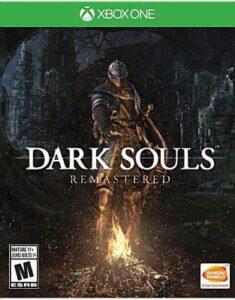
This influence usually shines through mechanically, in the form of experience points that can be regained upon death under certain circumstances, checkpoints that cause enemies to respawn, and—sometimes, but not always—grueling difficulty curves. Dark Souls and its successors are infamously difficult, to the point where it is quite easy to get stuck on the first boss, give up, and never play the game again. In some ways, the difficulty of the Souls games can be very frustrating, leading to tears of anger and grief, as when you get to the boss down to one hit but, in your haste to defeat it, become too aggressive and die for your troubles. The flip side of this difficulty, though, is that because you have to struggle so much to succeed, the emotional reward is much greater. There are very few things more satisfying than defeating an enemy that’s taken you hours or maybe even days to get past, and that’s just not replicable in a game that doesn’t embrace its difficulty in the way that the Souls games do.
Interestingly though, while difficulty is major design choice in the Souls games, it also functions as a thematic one as well. The premise of Dark Souls is that the fantasy kingdom of Lordran has been cursed with undeath—when people die, they are revived after a short time, losing in the process some of their sanity. Most of the enemies you fight in the game are people who have died so many times they’ve gone “hollow,” with no memories or goals other than to attack you, the player. Just as characters in-universe slowly go mad through the unending cycle of death, so do you, the player, and the only way to overcome this madness is to beat the game and break the curse.
I don’t really expect the Souls games to appeal to everyone, though. You have to have a particular relationship with video games to enjoy them. If you like games to be a relaxing way to wind down after a long day at the soup factory, you will probably not like these games. Instead, I’m going to be focusing on readalikes; that is, books that share similarities, mostly thematic, with the Souls games.
Now, for a book to be the Dark Souls of reading, it would need to do something weird like give you paper cuts every time you turned the page. For legal reasons, we don’t have any books like that, but we do have books that share similar themes as Dark Souls—books that deal with subject matter like memory, overcoming impossible odds, and fighting against vast and impersonal powers, as well as books that are set in expansive fantasy worlds that inspire a sense of wonder.
With the exception of the Lord of the Rings books, all titles listed are part of our Adult Fiction and Adult Graphic Novels collections.
Lord of the Rings by J.R.R. Tolkien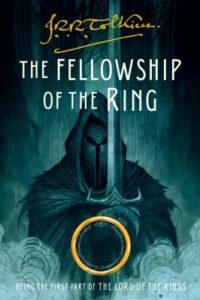
This one is pretty obvious. Tolkien’s classic fantasy trilogy, like Dark Souls, is set in a post-apocalyptic world, after the fall of the great empires of both elf and man, and follows a mismatched group of heroes opposing a terrible, corrupting evil on a quest that involves both determination and self-sacrifice.
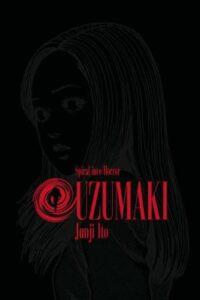
While this comic has more in common with FromSoftware’s Bloodborne than the Souls games—especially as the story progresses and things get a lot weirder—like Dark Souls it takes place in an isolated location afflicted by a strange curse, though where Dark Souls is fantasy with only a dash of horror, Uzumaki plays heavily into horror with the fantasy elements taking a backseat. Both Dark Souls and Uzumaki also feature cyclical narratives—repeating events that the protagonists have very limited control over (although to say more might lead to spoilers).
The Girl from the Other Side by Nagabe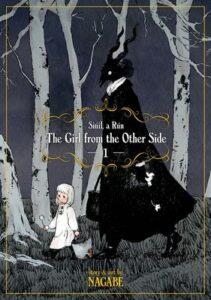
Another manga series, The girl from the Other Side is set in a fantasy world where humanity has retreated behind defensive walls to prevent the spread of a curse that turns the afflicted into “outsiders,” little more than mindless husks. The main character is partially cursed while still retaining a great deal of sentience and volition, and takes it on himself to protect an abandoned child being hunted by other outsiders as well as human soldiers.
Step by Bloody Step by Si Spurrier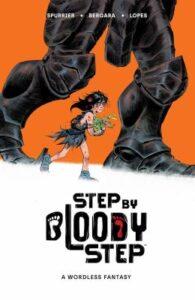
This wordless comic takes place in a world of depopulated ruins and empty landscapes that call to mind the world of Dark Souls both in its setting, where friendly wanderers are few and far between even in great cities, and in its ability to inspire wonder. This second quality is bolstered by the lack of dialogue in the story: in the absence of concrete statements, or even conjecture, we are literally left to wonder what keeps the protagonists (a young girl and her knightly guardian) wandering, and what could possibly have happened to the world—one where there are in fact pockets of highly developed technological societies—to leave it in such a state. For me personally, this emotion is similar to what I feel playing Dark Souls, where every time you enter a new area you have to contend with what catastrophe could have left the world in the state it’s in.
The Fifth Season by N.K. Jemisin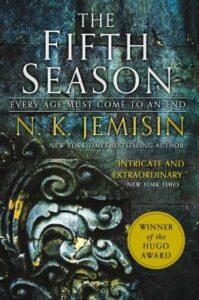
The first book in Jemisin’s Hugo-winning novel shares many similarities with Dark Souls—not the least of which is that both works prominently feature cycles of destruction and rebirth. In the setting of The Fifth Season, the Stillness, extremely powerful earthquakes and volcanic explosions drive this cycle, rather than the more explicitly fantastical elements in Dark Souls. Where Dark Souls emphasizes overcoming adversity, as befits its medium, The Fifth Season is more interested in the social fabric of the apocalypse and in how life goes on even as the world ends.
I will be honest, the only reason The Fifth Season was on my radar is that it came up when I did the sophisticated move of searching for “books like Dark Souls,” and while it definitely comes extremely close to Dark Souls in terms of setting, it ended up diverging a lot more than I was expecting. Obviously two authors can take the same premise and end up with very different works, but I think that the medium itself is also a factor here. Gaming lets you be involved in the plot in a way that’s hard to replicate with even the most immersive fiction, and for that reason alone I think it’s worth exploring for readers.
Browse the Souls games in our catalog.
We also have Elden Ring by the same developer