

On July 4th, the Rogers Public Library celebrates its birthday – it’s 121st this year! But did you know that that has only been the case for about 50 years? In fact, the library’s true birthday is almost one full month earlier. So, while we celebrate the library’s birthday this week, it has actually been 121 years old for some time now. How did that happen, and why? Follow along in the account of the library’s history below to unlock a story about how a few discrete changes over the decades shifted the library’s birthday by nearly a month; and how one librarian’s quest to organize and establish an archive for our history revealed what may have been a decades’ long mistake.

Courtesy of the Rogers Historical Museum. The Rogers Woman’s Study Club. Mary Parks, the library’s first Head Librarian, is the second woman in the first row.
In 1904, the Rogers Public Library opened its doors on the second floor of a local grocery store at 1st and Poplar Streets with 458 volumes available for checkout and Mary Parks serving as Head Librarian. First organized and operated by the Rogers Woman’s Study Club, the library became an entity of the City of Rogers in 1933 and has been housed in six buildings in its lifetime. In the first half of the century, that included the original grocery store space, overtop a drugstore, in the high school gym, and City Hall.
The first dedicated building for the library was the former Rogers Post Office, built in 1917, then renovated and optimized for library use with the help of Cass Hough, the President of Daisy Manufacturing. Overseen by Head Librarian Ruth Osgood and with the help of local high school students, the library and its 10,000+ items moved into the new building in just one day, opening for the public in the fall of 1963.
The Rogers-Hough Memorial Library was formally dedicated on May 15, 1964, at a ceremony attended by students and presented by speakers including Dr. David Mullins of the University of Arkansas and the Mayor of Rogers Ed Bautts.
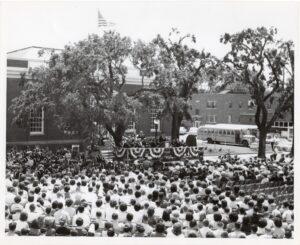
The dedication of the Rogers-Hough Memorial Library, May 15th, 1964.
For the next 30 years, the library saw the expansion of both the Rogers community and its collections in the little Post Office building. By the 1990s, the library offered over 42,000 items that included not just books but vinyl records, audio cassettes, VHS tapes, Polaroid cameras, microfilm, magazines, newspapers, phone books, printing services, a fax machine, and more.
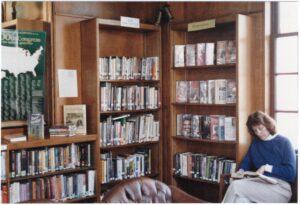
A woman sits by the window at the Rogers-Hough Memorial Library and reads a book, May 1987.
In March of 1992, the Friends of the Rogers Public Library acquired 3.924 acres at 711 South Dixieland Road for the construction of a new building, and the library as we know it today began. The Rogers Public Library opened its doors in its current location in the Spring of 1994 with an expanded collection of over 50,000 items, a state-of-the-art computer system, and a larger dedicated Children’s Library. In its first year in the new building attendance increased by over 70,000 visitors, the largest single-year increase in library history. Circulation increased by a record 51,000 items and new card registrations doubled.
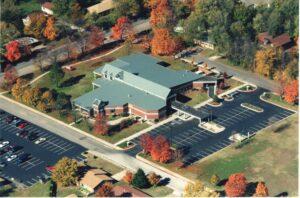
Aerial view of the Rogers Public Library, November 15, 1998.
Just a decade later, ground was broken during the library’s 100th anniversary for an expansion for an even larger Children’s Library, officially titled the Wal-Mart Children’s Library. By the time of this expansion, library collections totaled over 116,000 physical and digital materials.
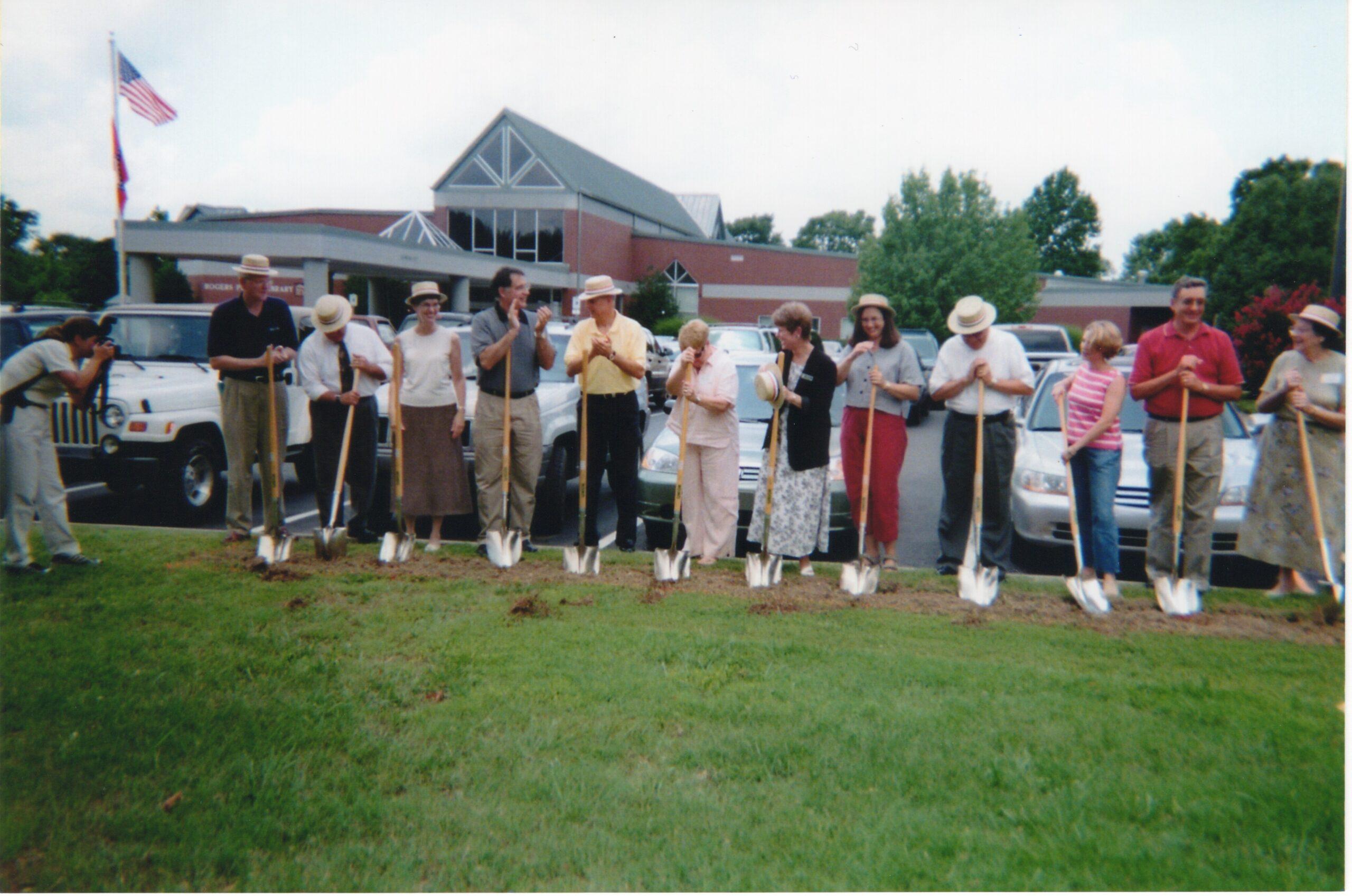
Expansion groundbreaking, July 10th, 2004.
Since opening its doors, the Rogers Public Library has circulated items more than 15 million items to over 7 million visitors – and that is just from data that was recorded and survived the decades. Today, the library holds more than 170,000 books, magazines, DVDs, audiobooks, CDs, video games, eBooks, databases, Playaways, books in braille, and so much more. Despite setbacks from a global pandemic in 2020 and a serious tornado in 2024, the library continues to serve the Rogers community in both traditional and innovative ways.

The Rogers Public Library, 2024.
So where does this take us in the journey to discover the library’s real birthday? It began in 2024, as we began to think about how to celebrate yet another library milestone – 120 years of serving the Rogers community. It was known by several staff that there were a couple large boxes of stuff in the back room that had been collected over the years for scrapbooking, though no one really knew what that stuff was. Years had passed, and the staff members who made scrapbooks for other anniversaries had all long retired, leaving the box and its contents to gather dust until a new staff member could come along to finally take care of it. That’s where the author of this blog comes in!
In the early part of the year, I formally dedicated time to taking the boxes from the craft room and seeing exactly what we had. I was in for a shocking, and yet incredibly exciting, surprise. There were thousands of photographs of staff, patrons, and the buildings the library had been in; there were thousands of sheets of paper, newspaper clippings, and brochures; and there were piles of the sort of ephemera you put behind glass in a museum exhibit. What I thought would be a quick sorting project turned into a full-blown operation. This wasn’t going to turn into a scrapbook anymore. It was going to become an archive.
After making an inventory of what we were dealing with, and starting an Excel sheet to create a master index of every item in the new archive, we ordered materials to house and preserve the various types of items. The archive is now divided into three main sections – photographs (including print photographs, slides, and negatives), paper documents (including paper, newspaper clippings, and any kind of ephemera on paper or plastic medium such as library cards); and artifacts (physical items that are not paper or photographs, such as rulers, textiles, buttons, stamps, etc.). The archive currently holds well over 3,000 photographs and thousands of paper records yet uncounted. The scrapbooks created by past staff members to celebrate the centennial were also retrieved from the Hudson Room, and placed with the archival material permanently.

The bulk of the Rogers Public Library Archives.
It was in the paper files and the scrapbooks that I came across some puzzling inconsistencies regarding the library’s recorded history. Since starting at the library, I had understood that we opened on July 4th, 1904. Everyone knew that the library’s birthday was July 4th. Indeed, many of the paper documents that I came across during the sorting and housing process had reaffirmed this. There are several histories of the library written by staff and volunteers that go back to at least 1976, each saying the same date. But then there was an article from the Rogers Sunday News that suddenly disputed that. Dated February 1976, the article titled “Woman’s Study Club instrumental in library founding” stated the following: “…it was not until June 4, 1904, that the first public library was opened in Rogers by the Woman’s Study Club.” Maybe just a typo? Could have been; it was, after all, only one month off and it was easy for someone to see something like a “7” in a numeric date and mistake it for June after forgetting which number the month is, or read “July” too quickly and mistake it for “June.”
But then why did another article say the exact same thing in an issue from May 10, 1964? After a trip to the Rogers Historical Museum to view their collections, we came across that article in one of their folders about the library. Also from the Sunday News, and essentially a word-for-word original that the 1976 article pulled from, this 1964 article titled “City’s Library History Began With Woman’s Study Club” was published just before the dedication of the library on May 15th and also reaffirmed the June 4th date. But wait, there’s more! The article from 1964 was itself a copy of another article from July 1, 1950. This article, in the Rogers Daily News, once again states the library opened on June 4th. And if that were not enough, the Rogers Daily News published an article yet again in 1956, titled “Rogers Public Library Has Shown Growth Under Leadership of Study Club,” that stated the opening day as…July 4th.
Putting my thinking cap on, I figured these inconsistencies among library-authored narratives and newspaper articles could mean one of two things – June 4th was the actual date of the library’s opening in 1904, and the librarians made a discrete change either on purpose or accidentally; or this was still a typo, carried for over 25 years thus far, and one that librarians continued to correct in internal narratives of the library’s history. I was convinced for some time that the latter must have been true. That narrative had been part of the library’s internally recorded history since the 1970s after all, that article from 1956 seemed to agree with them, and when librarians were writing pieces in the local paper in the 1990s it was being published to the public once again. In an article titled “4th of July is Rogers Library’s Birthday Too,” published on July 3, 1994 in the Northwest Arkansas Morning News and written by Director Alice Medin, we see the following: “Two birthdays are to be celebrated on Independence Day: the birth of our nation and the birth of the Rogers Public Library.”
When I sat and considered the roundabout date of the “official” change, however, a lightbulb went off. Pinning the library’s opening date to July 4th may have very well been an intentional decision by the library. So, let’s backtrack a bit as we go through this. At this point in organizing the library’s archival material, I had found newspaper evidence that the library’s opening date had been publicly accepted as June 4th since at least 1950. While a 1956 article mentioned a different date, June 4th was reiterated in two more articles in 1964 and 1976. The only other mention of the library opening on July 4th doesn’t come until a paper was written by Head Librarian Carrie Wright titled “Rogers-Hough Memorial Library: A History.” While this paper has no specified date, it gives collection and circulation numbers from 1975; so we can reasonably assume that it was written in 1976 at the earliest in order to have those numbers. What happened on July 4th, 1976? The nation’s Bicentennial. Could Wright have made an intentional choice to put in an authoritative, written record that the library was founded on July 4th in order to foster patriotic ties between the library and the community? On top of that, the library had begun submitting applications for Federal Construction Funds as part of a “long-range plan goal which would involve additional space for our present facility” – in other words, an expansion to the Post Office building – as early as November 1974. Perhaps if the library could position itself as a patriotic and vital anchor institution in the Rogers community, they could drum up enough support to fund an expansion of the library.
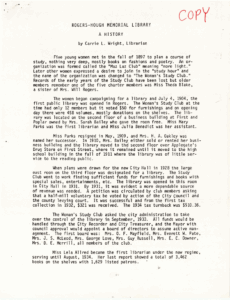
The first page of Carrie Wright’s ‘The Rogers-Hough Memorial Library: A History’ c. 1976
There is, of course, no written record of that decision being made that has been found. That newspaper article from 1976 continued to carry the June 4th date, even as Wright began using July 4th that same year. But with all of this discovery, there was still that looming question that hadn’t been answered. I had an idea that maybe July 4th wasn’t the library’s real birthday, so what was it? It turns out, the answer had been in the Hudson Room this whole time.
Around the time of the library’s centennial anniversary, some staff members had begun making scrapbooks to celebrate the library’s history – the project that essentially started all of this work. Those scrapbooks had been placed in the Hudson Room for public viewing until, as mentioned earlier, I had them brought to the back for placement in the archive for preservation purposes. After the research above I thought: perhaps those scrapbooks have some of the information I need? To my surprise, they did. The first newspaper clipping that stood out, dated June 1, 1904, reads: “LIBRARY OPENS JUNE 8.” That was a bit puzzling, since June 8th was neither June 4th nor July 4th. But since the article had mentioned that there were “delays” that prevented the original planned opening date of June 1st, there may have been more delays that pushed it back to July. Continuing through the clippings, I found another with a date of “6-15-04” – June 15th, 1904 – that read “Public Library Notes. ‘Gordon Keith’ was the first book taken out Wednesday and ‘Ben Hur’ the last.” It was recorded time and again in library histories and newspaper articles that these were the first books checked out at the library, so I knew this article was definitely about us. But June 15th? Maybe they wrote the wrong number on the clipping, maybe they meant 7-15-04. There was one telling clue in this article that would solve the mystery: Wednesday. Whatever the date, the library clearly opened on a Wednesday and a quick Google search would put this issue to rest. First, what day of the week did July 4, 1904 fall on? Monday. What day of the week did June 8, 1904 fall on? Wednesday.
With that, we had an answer. The Rogers Public Library opened its doors on Wednesday, June 8th, 1904. In fact, the library would not have been open at all on July 4th since their dates of operation at that time were only Wednesdays and Saturdays. And yet, after all that, still more questions surfaced that may never be answered. How did the original date get lost? Where did the newspaper reporters get their information? What was the real motive behind the adoption of the July 4th date? In the end, does the rediscovery of the opening date change anything besides 50+ years of library tradition?
That’s where you come in. After the work of organizing and digitizing the library’s archival material was put in motion, I began building a digital archive that makes much of the material I researched available to you, the public. Click on many of the images in the blog above, and you’ll find yourself taken there! Eight collections divide our digitized material among buildings, staff, patrons, programming, and more that you can view free of charge, no library card required. We also accept donations of materials from your time using the library, including photographs, paper documents, or other ephemera that we can add to our collections, both physical and digital. The collections contained online are still but a fraction of the material housed in our archive here at the library, and we encourage you to reach out with research questions that these materials may aid. And who knows, you might be the next researcher to unlock and solve another library mystery.