
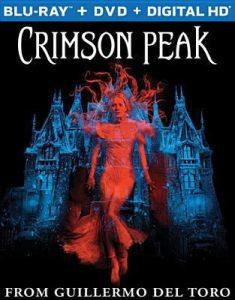
 Crimson Peak is a 2015 gothic horror film directed by Guillermo del Toro, starring Tom Hiddleston as Sir Thomas Sharpe and Mia Wasikowska as aspiring writer Edith. Thomas and Edith marry after a whirlwind romance and return to his country manor in Northern England. Here, Edith discovers that things are amiss: the manor is falling apart, red clay leeches up through snow like blood, ghastly specters appear in the night, and perhaps worst of all, her husband is keeping secrets from her. Edith’s efforts to uncover the things Thomas and his sister Lucille (Jessica Chastain) have hidden from her drives the film; the reveal is both shocking and thematically resonant, as the best reveals tend to be.
In some ways, Crimson Peak shows its age—special effects are inescapable, and audience’s expectations are a lot higher now than they were in 2015—but a combination of extensive practical effects and excellent art design means it holds up better than many of its contemporaries. These factors are especially important when considering horror films, as oftentimes they’re not just there for the visual wow factor, but also to anchor the thrills and chills that make the genre what it is.
Something else that works in Crimson Peak’s favor, though, has nothing to do with technology at all; on the contrary, it is the timelessness of the trope of the horrible husband that made the film so compelling to me. This conceit is old enough that Jane Austen lampooned it in her comic-gothic masterpiece Northanger Abbey over two hundred years ago, with young Catherine Morland convinced her suitor’s father murdered his wife due to reading too many fantastical novels. We also see hints of it in another classic 19th-century novel, Jane Eyre by Charlotte Bronte, wherein Eyre’s employer-qua-love interest Mr. Rochester

Gustave Doré, 1862; Public Domain
keeps his madwoman of a wife hidden in the attic.
Looking even further back, a similar notion pops up in the Bluebeard tale, fertile ground for contemporary works from Alison Rumfitt’s Tell Me I’m Worthless to Emily Carroll’s A Guest in the House. For those unfamiliar, Bluebeard tells the tale of a young woman married to a wealthy widower (the titular Bluebeard) who instructs her not to enter a locked chamber in their home; she, of course, does, and inside she discovers the bodies of Bluebeard’s previous wives. The key to the chamber is enchanted and reveals her trespass. Depending on the version, the wife either dies or is saved at the last moment by various interlopers. I’m not super fond of psychoanalytic readings, but it’s hard not to attribute the anxiety of Bluebeard’s wife—a woman put in the absolute power of a homicidal near-stranger—to the understandable fears of young brides in societies that give them little recourse when dealing with cruel or abusive husbands.
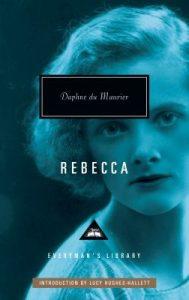 For a more recent antecedent, Daphne Du Maurier’s Rebecca (and its various film adaptations) spring to mind: the story of a young American who meets suave and wealthy Maxim de Winter on holiday and returns with him to his West Country manor as his bride. There she finds herself under the shadow of his previous wife, Rebecca, who drowned under mysterious circumstances. Much like Crimson Peak, Rebecca deals in sexual taboos, although, due to the mores of the time, these are more sublimated, a la the ambiguous nature of the relationship between the late Mrs. de Winter and cruel housekeeper Mrs. Danvers. Like the other men we’ve discussed here, Maxim keeps dark secrets from his wife, but Du Maurier portrays him as a victim of circumstance more than anything. Viewers of Crimson Peak will have a brilliant time comparing Maxim with Thomas Sharpe, weighing which of the two is more sympathetic, if either could be said to be.
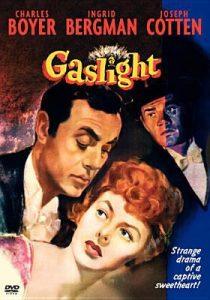 1944’s Gaslight, directed by George Kukor and featuring a young Angela Lansbury in her first film role, plays the villainous husband trope much straighter. In it, Charles Boyer’s Gregory psychologically tortures—here is where the term gaslighting arises—his young wife Paula (Ingrid Bergman) for 113 minutes to distract her from his criminal undertakings.
It’s hard to talk around spoilers for this film both because Gregory’s villainy is obvious almost from the get-go, and because Gaslight has entered cultural consciousness in recent years as “the film where a man convinces his wife she’s going insane.” That said, Gaslight is not the kind of film you watch so much for its twists and turns as for Bergman’s electrifying performance as a woman on the edge of sanity. Lansbury is delightful too, of course, as she always is, but she’s very much second fiddle in this Victorian noir flick.
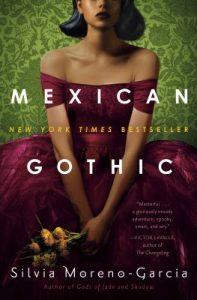 Lastly, I want to return to another novel: a contemporary one and, for a change, a North American one. Silvia Moreno Garcia translates the gothic tradition to the Mexican Altiplano, the fog-dense mountains sitting backstock in her aptly named Mexican Gothic. Here, Noemi Taboada travels from Mexico City to visit her cousin Catalina in a former mining town high in the mountains, where Catalina lives at her husband’s crumbling mansion with his aristocratic—and insular—English family. You expect by now that Catalina’s husband Virgil is the villainous one, the degree of separation between him and Noemi giving a bit of a twist on the dynamics we’ve discussed so far. And of course, he is, but he’s also a secondary antagonist; the identity of the primary antagonist is a major spoiler, so you’ll have to read the book to find out more.
Unlike other books mentioned here, Mexican Gothic has not received a screen adaptation. That said, it received a Locus Award in 2019 and precipitated a slate of similar Latin-American gothic horror fiction both by Moreno-Garcia herself and by the remarkable Isabel Cañas.
Originally, this blog post was intended to come out closer to Halloween, but rather fortuitously, it’s now the dead of winter, and I hope some of the works discussed here give you plenty to watch and read as you wait out the winter chill, safe from monsters both inside and out.
Shelby S.